King Lear

William Shakespeare, adapted by Matthew Dunster
Royal Exchange Theatre
Royal Exchange, Manchester
October 2-November 15, 2026: 3 hrs 10 mins


It was brave of the Royal Exchange to choose King Lear as the Shakespeare in their 50th anniversary “Homecoming” season, with the memory (for some of us) of Don Warrington in the title role just 10 years ago still clear.
This time the Manc-ness of the project is obvious: director Matthew Dunster, born and raised in Oldham, returns to the theatre in which he has appeared in, or directed, more than half a dozen productions. As Lear there’s David Threlfall, also returning to his home turf. Several other cast members are Manchester-trained or North West based.
There’s a policy, it seems, for the characters who are (or pretend to be) of the common people, and those who are the good guys, to speak with Northern intonations (except for Nicholas Karimi’s Albany, who speaks like a Scot – presumably because we all think Scots voices denote honesty and probity). But the timing and location of the play are indistinct, as of course they often are, other than that the costumes (Cat Fuller) are more or less present-day.
Dunster has brought his long-time collaborator Anna Fleischle as set designer, and her stage is often bare, with a pattern of fissures across it, cemented with gold as in kintsugi pottery. I think the idea is to symbolise a world that is cracking up but can still, perhaps, be mended.
There are circles of light-weight golden chains (nicely lit by Lucy Carter, whose work is effective throughout) which can ascend and descend and are used to spatially mark out scenes that so often hop from place to place, to indicate imprisonment where it is part of the story, and also (less communicatively) to point to affinities and key relationships. There are a number of portable props, too, used when they can be got on and off easily.
But, as is useful in other Shakespeare but vital in this, the sound (Holly Khan) provides the scenery. We get two very good storms (with a highly localised downpour of real water for Lear’s “Blow winds…”), there is birdsong for the great outdoors. Throughout the play, composed music by Nadine Shah merges with the soundscape.
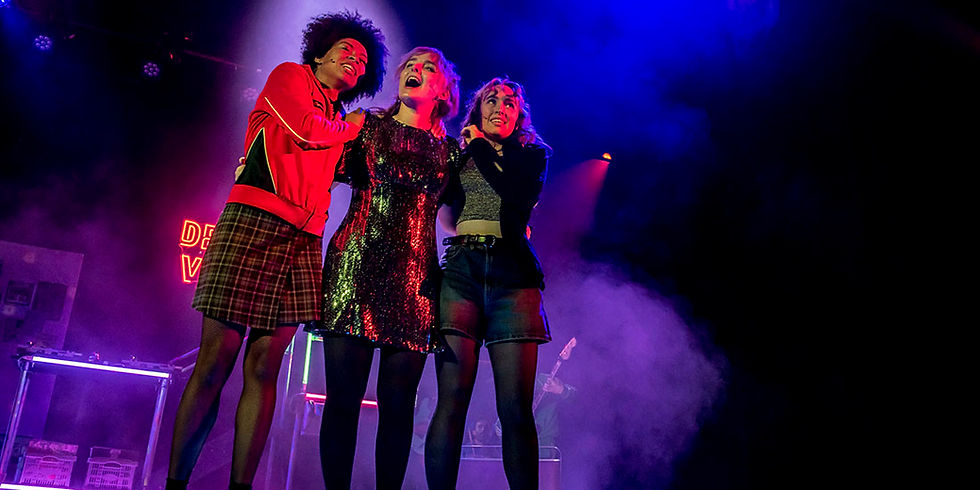
The opening – introduced by Lear’s line “This night will turn us all to fools and madmen” – is a glamorous, entitled gathering for the undivided family he is about to reduce to warring factions: there’s about 10 minutes of dancing and karaoke (even with a snatch of La Bamba), then we get to the beginning of Shakespeare’s play.
That’s one aspect of the “edited version” Matthew Dunster offers of King Lear. Another is that the Fool does not appear at all: where we hear his lines, they’re in the mouth of Lear himself – talking distractedly as batty old men can, I suppose.
There have been other cuts and alterations, though the show still runs to over three hours, including the interval. It’s all in the cause of clarification and immediacy, but one (possibly unanticipated) effect is that the audience sees laughs in the text and goes on seeing them. When the moribund Lear awakes near the end, sees a nurse with a small tricolor on her uniform, hears her speak and says: “Oh God, am I in France?” there’s a huge burst of amusement (or there was on Press night). It isn’t the only example: the eye-gouging got its titters, too. A post-modern view of tragedy, perhaps?
Nonetheless, David Threlfall’s interpretation of the title role is interesting and constantly engaging. He has a wavery, elderly voice at the beginning, but grows stronger later. His early pauses, as if the old man is beginning to lose his way, could be meant to imply some form of dementia – but dementia is progressive and the later writing can’t be made to mirror that, so he seems unable to take it anywhere. Most effectively, his transformation from hubristic and tantrum-throwing tyrant to the man of compassion who engages with “Poor Tom” is a challenge to the spectator: which one is (or was) sane and which one was (or is) mad?
None of the three daughters - singer-songwriter Nadine Shah as Goneril, Lisa Diveney as Regan and Isobel Akuwudike as Cordelia, is very likeable, which must be deliberate in Cordelia’s case – we’re seeing the consequences of a bad decision all through the play. But there are some very accomplished performances in the male roles: Jonathan Slinger’s Gloucester, Jason Done’s Kent, Ed Coleman’s Cornwall, Paddy Stafford’s Edmund in particular.
In fact, as in every Royal Exchange show, there are no really weak links and the whole thing is excellent value.
More info and tickets here