The Memory of Water

Shelagh Stephenson
Octagon Theatre Bolton and Liverpool Everyman & Playhouse
Octagon Theatre Bolton
January 29-February 21, 2026: 2 hrs 30 mins
,(also at Liverpool Everyman Theatre, February 25-March 14)


Thirty years on from its London opening, The Memory of Water is still a funny, incisive, thoughtful and entertaining look at a part of life none of us can avoid. In the midst of life, we are in death, as the old prayer puts it, and that’s what the play shows.
Widowed matriarch Vi has died: her three daughters gather at her home (one of them sleeping in her vacated bed, the others in the spare rooms) to sort things out and prepare for her funeral. It’s winter, and snowing fast.
They’re very different people, these three sisters. Mary has got the most from her education and is now a hospital consultant – she’s in a relationship with a married doctor colleague called Mike; Teresa is running a health food business with her husband, Frank; Catherine, by a long way the youngest, hasn’t got a job and hasn’t got a man (though she’s currently fixated on a guy called Xavier whom she met in Spain).
It would spoil it to give away too much of what happens: each of the daughters has past baggage which comes out slowly in the course of the story - one reason it’s so brilliantly written). Their relationships are capable of flaring into bitter arguments as well as leading them to comfort one another; they discover things about themselves and their partners they never knew before.
And then there’s Vi, the deceased. She’s there sometimes, too, not just inside a box but as her younger self, as Mum (to Mary in particular). Is she a ghost, or in their imaginations? It doesn’t really matter, but she’s there all right, and she talks to them and they to her.
There’s something a bit Stoppardian in the philosophical and psychological themes that pop up in the play. “Recollections may differ,” as someone once said, and part of the undertow is about memory and memories. Why do two people remember the same thing quite differently? How do we process our memories and how do they form us? There’s even a brief excursion into the concepts behind homeopathy – can something effectively no more than water carry a kind of imprint from the past that affects the present - hence the title?
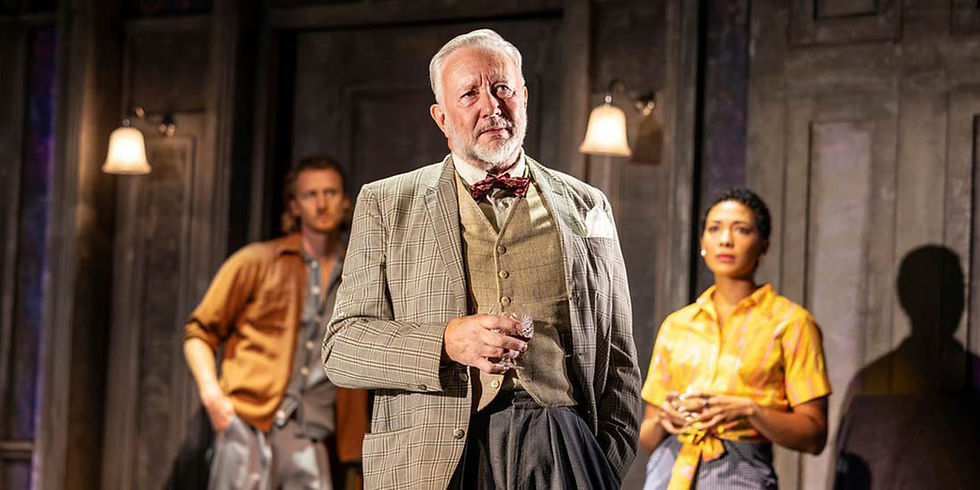
This co-production between Bolton Octagon and Liverpool Everyman, directed by Bolton's Lotte Wakeham, doesn’t put a foot wrong. Katie Scott’s set and costume design places it right in its period, and the beautifully detailed set at Bolton is in thrust stage shape, with the audience on three sides. The sound design (Andy Graham) gives us evocative songs from the era and before (including Nat King Cole, named in the script).
And what I particularly like about it is the way the performers create their characters, not as stereotypes but as people who are quirky enough to be real. Polly Lister, as 39-year-old Mary, is both intellectually heavyweight and relationally very down-to-earth. Victoria Brazier, as Teresa, is outwardly on top of things but has demons of her own. Helen Flanagan, as Catherine, is over-the-top, a baby in an adult body, but not surprisingly as she’s on joints and shares them. Vicky Binns, as the departed Vi, is the one who had a harder time than any of them but fought through with inner toughness. Each of the them has a virtuoso monologue (or near-monologue) in the second part of the play – Mary and Vi together, as it happens.
The men’s roles are less sympathetic or subtle, but intelligently taken by Charlie De Melo (Mike) and Reginald Edwards (Frank) – they’re partly there for the laughs, and this is a show with plenty of laughs, which makes it great fun. But it also has a few messages: “Forgiving is sometimes just like flicking a switch – and then you’re free” … “Learn to love the cold” ... and so on. That’s what makes it so deep.