The Sound of Music

Howard Lindsay and Russel Crouse (book – suggested by The Trapp Family Singers by Maria Augusta Trapp), Rodgers & Hammerstein (music and lyrics)
Curve Theatre Leicester and Opera North
Grand Theatre, Leeds
July 9-August 1, 2026: 2 hrs 35 mins


The 1965 film of The Sound of Music, with Julie Andrews, is so familiar and loved that most of us have forgotten it was adapted from a stage show, first seen six years earlier.
The last great success of the Rodgers and Hammerstein partnership that dominated the Broadway musical for a decade and a half is part of theatre history – from an era when large live orchestras and soloists who could really sing were essential.
So there’s every reason for a lively-minded opera company, with a symphony-sized orchestra and large, multi-talented chorus to match – such as Opera North – to remind us how it really should be done.
Opera North has teamed up with Leicester’s Curve Theatre (for which it was the most recent Christmas show) to bring this production, by Nikolai Foster (of Kinky Boots, My Fair Lady and A Chorus Line fame), to Leeds. The revival director is Ollie Khurshid.
And the casting is – mostly – of operatic voices. Katie Bird is both an opera singer with a solid track record and a singing actress who can deliver a show song: she avoids the saccharine sweetness that just might have been expected by anyone who knows the film and nothing else, and makes Maria a flesh-and-blood individual with a good heart (Lucy Carter takes the role for three Thursday evenings).
Katherine Broderick, another Opera North regular principal and also a singer who can really act, is a perfect Mother Abbess.
Almost all other adult roles are filled by members of the Opera North chorus. To those who see the company’s productions regularly, names will be familiar: Amy Freston (channelling her inner Marlene Dietrich as Baroness Schraeder), Kamil Bien as a convincing young Rolf, Claire Pascoe as a Yorkshire-voiced Frau Schmidt, Molly Barker-Knowles, Hannah Mason and Gillene Butterfield as the principal nuns, Nicholas Butterfield’s burnished baritone as Max Detweiler, Dean Robinson as Franz, Ivan Sharpe as a very villainous Herr Zeller, and others.
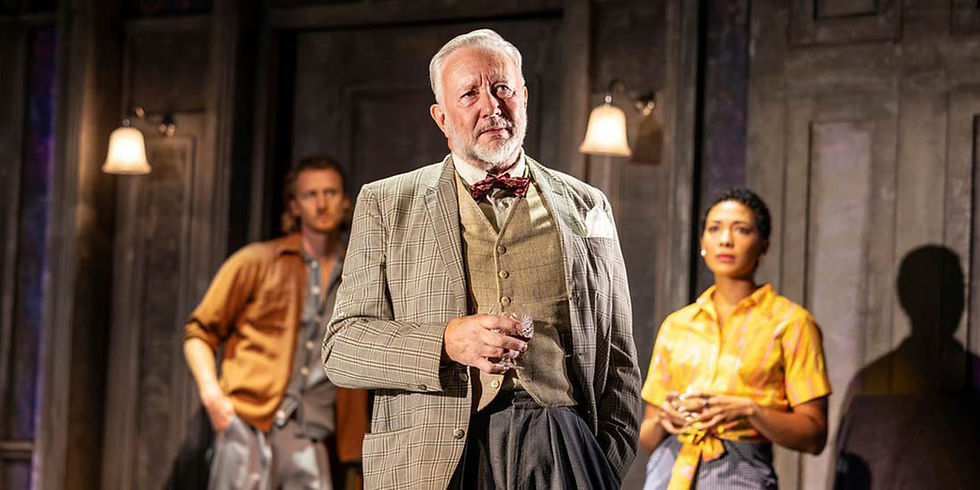
There are two singers as Liesl (as there are two teams of the other von Trapp children): I heard April Perrott, who was very good; the other is Abigail Sinclair. Edward Bennett (Captain von Trapp) is primarily an actor, which shows against such a quality team of singers: he gives the Austrian patriot a rather British diffidence – paternal, but not as the story leads you to expect (Tom Stoddart takes the role on those Thursday nights).
Then there are the children: they’re almost all experienced young performers and can handle the singing requirements well.
But how could any designer compete with the breathtaking panoramic shots of the Austrian countryside in the Julie Andrews film, or the Mondsee Abbey for the wedding; the Mirabell Gardens as the Doh-Re-Mi setting, or the Felsenreitschule auditorium in Salzburg for the song festival?
Well, Michael Taylor manages something pretty spectacular in his single, built-up backdrop to the stage, which gives Maria and other characters a considerable mountain to climb up – or down – and he flies in a symbolic window with gothic tracery to evoke the abbey, and rolls on a small but impressive piece of baroque architecture, with staircase, to bring us the von Trapp palace.
Lighting design, by Mark Henderson, is strikingly effective, particularly in the wedding scene and the finale, where the whole auditorium gets the Nazis’ hunt for the escaping family. Choreographer Ebony Molina makes a great contribution for the children’s set pieces – though her dancing nuns were a bit reminiscent of Sister Act, and the chorus’s Ländler was hardly of Strictly standard.
The opening is beautifully done, with (I think) a whiff of incense to accompany the chorus’ Praeludium – one of several pastiche numbers Rodgers put in the score (Edelweiss as an unforgettable imitation folk song, and the yodel-style Lonely Goatherd are others). And two songs are included that didn’t make the film (plus some restored to their original positions compared with it), as well as an after-interval entr’acte, so you get value for your money.
Oliver Rundell conducts the Orchestra of Opera North with energy and smoothness as occasion demands: only at the very start on this first night did there seem to be a slight disconnect between back-of-stage Maria and her accompaniment, soon remedied.
One minor grouse: since the pronunciation is accurate enough on words like “Fraülein” and “Edelweiss”, why couldn’t they say “von”, “Salzburg” and “Nonnberg” as Austrians would?
PS: The real von Trapps didn’t actually climb any mountains to get to freedom. They got on a train the day before the Anschluss...
More info and tickets here