The Spy Who Came In from the Cold

David Eldridge, based on the John le Carre novel
Chichester Festival, Ink Factory, Second Half Productions
Lowry, Salford
July 22-25, 2026; 2hrs 10 mins


John le Carre's novel The Spy Who Came In From The Cold was the breakthrough that set the standard and tone for spy novels for the latter half of the 20th Century, even after the fall of the Berlin Wall. Le Carre dominated the genre for dedicated readers and reached a much wider audience, particularly with Tinker, Tailor, Soldier, Spy redone for television and cinema.
Sixty years after the novel's publication, the work is now also staged, by Chichester Festival Theatre in a highly–acclaimed production written by David Eldridge and directed by Jeremy Herrin.
Both on the page and on screen, The Spy Who Came In from the Cold is a riveting journey through the fog-shrouded terrain of Cold War espionage, deception and moral compromise. What, if anything, can the stage add?
The story centres on British spy Alec Leamas, running an operation in East Germany. Having watched a friend and colleague betrayed and killed, he seeks retirement from the service, but is persuaded by "Control" to undertake one last operation, designed to implicate German senior spy and former Nazi, Mundt, as a British spy - a double agent. If successful, this will not only protect the British operation but seal the revenge Leamas seeks.
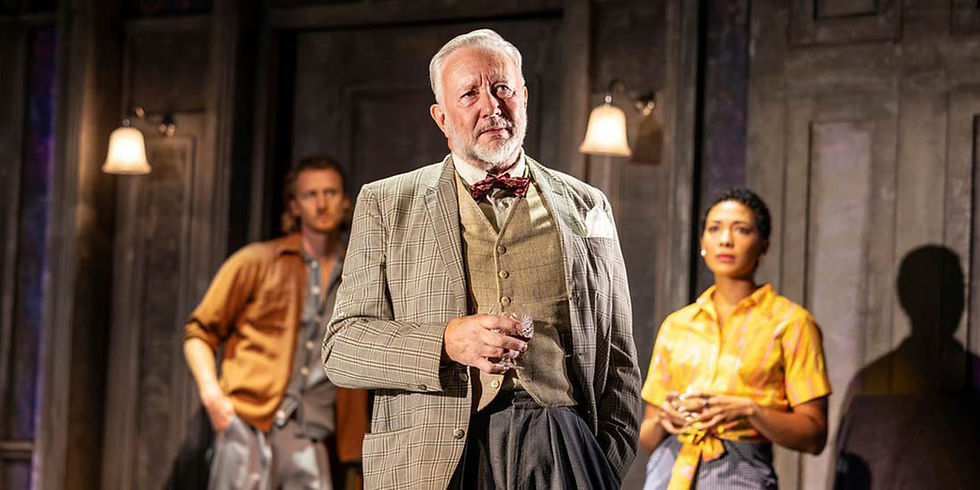
It's a complex tale, at times not easy to follow, but the writing and direction bring the inner torment of Leamas as the central character, and the moral uncertainty of spying, even while it claims to protect us. Leamas is often isolated, and conducts an inner dialogue with the characters in his life. These characters are on stage with him when he's alone, and also when he is in actual conversation with other characters. Particularly important are George Smiley, a vital figurehead within the spy network (and le Carre's novels), located in London's Cambridge Circus, and Liz Gold, the woman he works with in his librarian disguise and with whom he is possibly in love.
The technique of staging the voices in his head is introduced gently, by placing Smiley on a bridge looking down on him. Eventually, he speaks. For those of us in the audience - I guess this is most of us - who are familiar with le Carre's work, it is easy to identify the character, his worth and his integrity. But as my companion pointed out, his unannounced presence could well be confusing for those new to the "Circus", as the spies refer to it.
Set design (Max Jones) is effective: simple, dark and stark, with a constant reminder of the recently- constructed Berlin Wall. Lighting (Azusa Ono), sound (Elizabeth Purnell) and composition (Paul Englishby) are sharp and add considerably to the atmosphere and storytelling.
The acting is strong throughout. Tony Turner as Smiley is sincere, challenging and supportive. He also plays the prosecutor in the second act's trial scene with conviction, as someone motivated to reconcile his ideological commitment with his respect for legal process.
Ralph Little is Leamas carries the weight of the production and effectively projects his inner turmoil. He is quick to enrage - a characteristic I had not thought very common in the world of espionage, though of course this is man living on an emotional edge. Grainne Dromgoole portrays Liz Gold, Leamas's girlfriend, with charm and considerable conviction.
The second act has a stronger drive and clearer narrative than the first. We see interrogation and courtroom drama; scenes with which we are all familiar. The water torture scene is astonishingly good, and rightly disturbing.
Though the world has changed more than once since the end of the Cold War in which these stories are set, interest in the tradecraft and the moral ambiguities of spying and espionage remain strong, and this play is a worthy addition to the art of portraying that world.
More info and tickets here