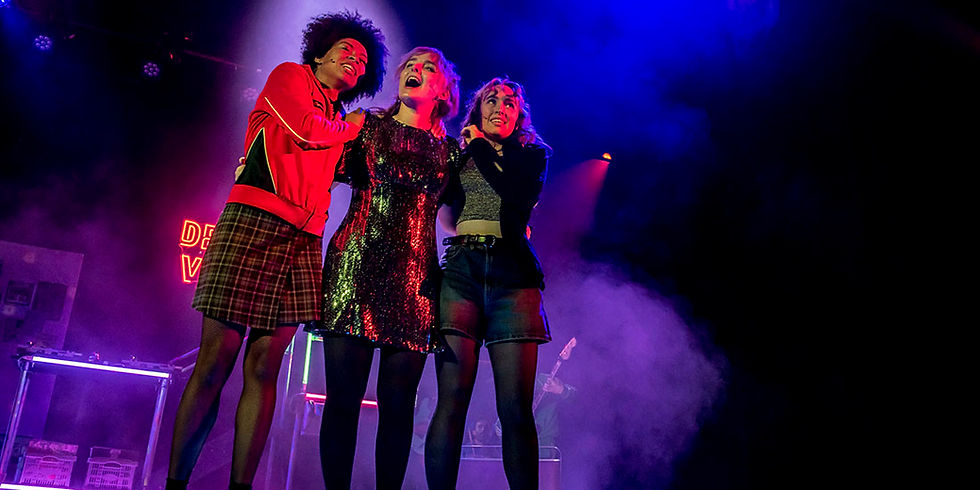
Twelfth Night

William Shakespeare
Theatr Clwyd production
Theatr Clwyd, Mold
April 25-May 16, 2026; 2 hrs 30 mins


There is often a problem, these days, in productions of Shakespeare. His magisterial works ought to be, perhaps need to be, showcased, but many producers obviously desire to go their own way for whatever reason, to make their version distinctive.
Director Juliette Mann chooses here to take what is possibly implied and makes it overt: a queer theme within Twelfth Night.
The company's rationale is "to connect a classic play to urgent contemporary conversations about visibility and acceptance". Twelfth Night is essentially a farce with a love triangle between Duke Orsino (Garmon Rhys), Countess Olivia (Bethan Rose Young) and Viola (Lee Braithwaite) at its heart, the last of whom, after being shipwrecked with her twin brother Sebastian (Jax Guerrero), takes on a male identity, Cesario.
The shenanigans that unfold from this set-up offer plenty of tomfoolery. Lady Toby (Lucy Ellison), Sir Andrew Aguecheek (Joseph Benjamin Baker) and Maria (Philippa Cole) target the pompous Malvolio (Phylip Harries) to hilarious effect. As the climax unfolds, several couples emerge, Sebastian and Antonio (Oncel Camci), who rescued him from the shipwreck; Lady Toby and Maria, then Olivia and Cesario, who here comes out as a trans man.
It takes a while for the comedy to warm up; after all, an audience needs time to get accustomed to Shakespeare’s rhythms, which remain largely unchanged in this production and are spoken most clearly by Bethan Rose Young (Olivia) and and Philippa Cole (Maria). Many scenes are both imaginative and very funny, including where Malvolio receives the forged letter saying Olivia loves him, and dresses in a gold lame suit to impress her but instead finds himself locked up as a madman.
Most slapstick moments come from the supporting actors. Lucy Ellison is superb as Lady Toby, Philippa Cole has a really good comic touch and Phylip Harries camps up Malvolio to great effect. The costumes (Cai Dyfan) are slightly strange - at times traditional, at others retro, with no obvious theme holding the looks together.
But for all the fun, one wonders whether in pursuing an agenda, the production loses sight of Shakespeare’s story. Some changes are obvious: the text points strongly to Sebastian and Antonio having a same-sex attraction, and to have them together at the end would be credible. Despite enjoying Lucy Ellison’s performance, must Sir Toby become Lady Toby? Must Feste the court fool be a drag queen? The answer, of course, is that there is no clear reason why they shouldn't; Shakespeare's shoulders are big enough to have absorbed hundreds of interpretations over the centuries.
But by pointing the play at a specific gender discussion, making all successful relationships queer, the production ignores the importance of women and of so-called outsiders. In the original, Viola assumes a male identity so she can fend for herself, but ends up in a relationship with a duke. Not bad for a female and a foreigner! Originally, Olivia gets a love match with an outsider despite the entreaties of a powerful man. In promoting the interests of one group that is discriminated against, the production forgets the trials of other groups, also discriminated against. Sometimes the Bard’s stories need to be left to speak for themselves.
Having said that, none of it detracts from what is a highly entertaining production that fulfils the purpose of a night of merriment. The audience's appreciation was warm and genuine.
More info and tickets here