


Atlantis

Emily White
Theatr Clwyd and Chichester Festival Theatre production
Theatr Clwyd
June 8-July 4, 2026; 2 hrs
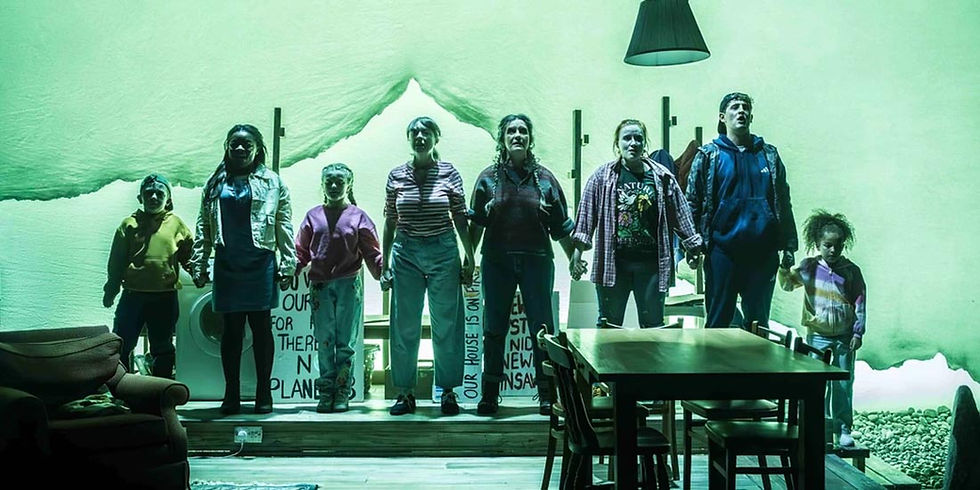

To what extent should we be concerned about ecological disaster, and how important an issue is it, compared to other thorny political issues?
These questions lie at the heart of Emily Wrights play, Atlantis. The play pictures a family whose members feel deeply about political issues, in particular that of global warming and rising sea levels. But their degree of commitment varies, which leads to conflict. They live in a village in north west Wales, where 700 houses are surrounded on three sides by water. A decision is made to stop reinforcing sea defences and manage a staged evacuation, to allow the sea to flood in.
Not surprisingly, this raises much anger among the villagers, as their livelihoods and legacy are under serious threat. Much of the play sees family members arguing the issue to find the best way to oppose the decision. The first act sets out the scenario and the second is more speculative, exploring the consequences that might arise.
The six adult cast members in Guy Jones' production give a compelling performance and are ably supported by three child actors who are lively and at times precocious. Vivien Parry as Gwen, the grandmother, is a former Greenham Common protester and is warm, imaginative and determined. The dynamic between Gwen and her husband Bryn, played by Ricard Elfyn, ranges from loving to antagonistic. Eirlys Lovell-Jones as their granddaughter Rhiannon is passionate and idealistic at first, before becoming embittered. Gwen and Rhiannon are zealous in their activism, to the point where their health and welfare are threatened. But their attitude is counterbalanced by Claire, the daughter (Catrin Aaron), who takes a pragmatic, wider-ranging rather than idealistic approach - well, she's a low-paid single mother forced to go back to her old family home to make ends meet, so she would.
The first act capture the attention and fires imaginations really well, exploring the dilemmas caused by rising sea levels and how best to challenge decisions that have profit rather than people at their forefront. The second act, set in the near future, has a more tenuous connection to climate change but explores issues like press freedom, restrictions on human rights and dementia. As a result the play loses its focus slightly and there is one logical inconsistency. Bryn persistently expresses a secular humanist, atheist standpoint, but when a crisis comes he cries out to a metaphysical being - then berates that being for not answering. He really expects an answer from something he doesn't believe exists?
This doesn't detract at all (in fact it reinforces the irrationality people in fear descend to) from what is a thoroughly thought-provoking evening.
Whatever one believes about environmental degradation, the play is based in fact: around 160,000 homes are under threat of inundation in the UK alone, and the village of Fairbourne on Wales' west coast has been identified as "unsustainable to defend", given predicted sea level rises and despite fervent local opposition.
This is not a popular topic for many people, so the play is a brave attempt to explore the issue. From the evidence displayed, we need as a society to be much more active in our effort to combat damage to the environment.
More info and tickets here


