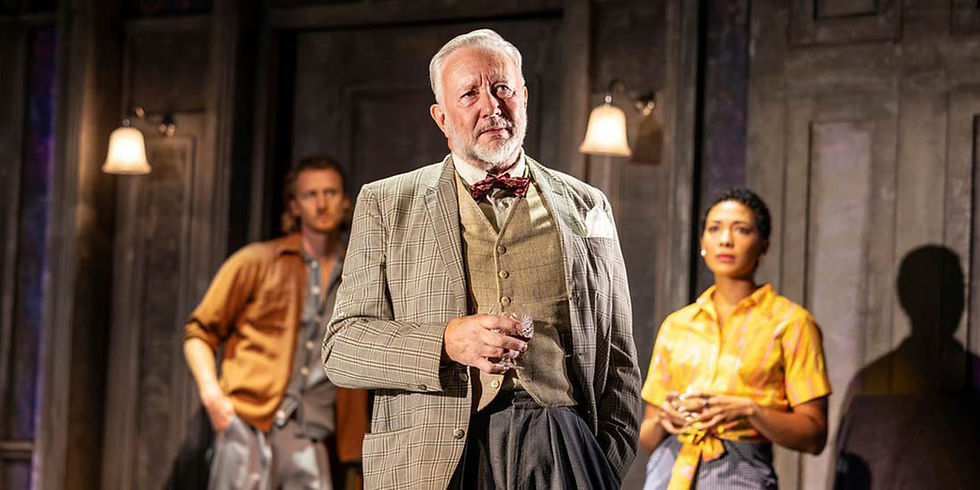
The Talented Mr Ripley

Adapted and directed by Mark Leipacher from Patricia Highsmith's novel
Thomas Hopkins Productions, Jack Maple Productions, The Faction
Lowry, Salford
November 17-22, 2025; 2 hrs 35 mins
(Also at York Grand Opera House, January 19-24, 2026)


In Patricia Highsmith's classic 1950s story The Talented Mr Ripley, at our first sight of Tom Ripley he doesn’t seem very talented at all; just a small-time con man living in seedy digs.
As he later admits himself, he's a nobody.
Then wealthy businessman Herbert Greenleaf asks him to go to Italy, all expenses paid, to persuade his son Dickie to return to home to America. Soon Tom is on the Amalfi coast, inveigling himself in the dolce vita world of would-be artist Dickie and his sort of girlfriend Marge, a would-be writer.
With a lot of plotting by Tom, he and Dickie become inseparable, and Tom is fascinated by his new “friend”- his watches, his rings, his home, his yacht. He imagines himself as Dickie to the extent of trying on his clothes. But when this is discovered, the relationship turns from love to hate – with fatal consequences. Tom decides to take on Dickie's identity.
It is from this point that Ripley really shows where his talents lie. He is highly intelligent, a great mimic, has powers of persuasion and deception and, at times, can be ruthless, remorseless and amoral. One lie leads to another, and another.
Patricia Highsmith’s 1950s novel has been adapted for the current touring production by Mark Leipacher, who also directs. It is very faithful to the somewhat complicated plot, and much of the dialogue is based on the original - though the play, frankly, is too long.
The minimalist set, by Holly Pigott, suits the Lowry’s smaller Quays theatre, but there are some difficulties. The set has a large, raised platform with a big hole in the middle, through which actors and props appear and disappear. It works when it is supposed to be the sea, for example, but at other times just seems odd.
It is also important to remember that Highsmith’s original placed much emphasis on the fabulous locations in Italy that so seduced Tom Ripley – as indeed they did with anyone who watched Anthony Minghella’s 1999 film. In this production there is no visual difference between one place and another, so we are left with the equivalent of the actors going “So here we are in Naples/Rome/Sicily/Venice”. Dickie’s lavish and crucially, enviable lifestyle, can’t be replicated with a bit of a black hole.
The sound (Max Pappenhaim) helps to dissipate this to some extent: seagulls, splashy water. It is also used to good effect in the well-designed fight and (mild) sex scenes (Jessica Hrabowsky). The lighting (Zeynep Kepekli) is effective, warm in the sun for example as well as highlighting key moments.
A couple of other gripes before moving on to what are indeed some strengths.
At various points during the play, the action is halted by what appears to be the filming of Tom Ripley’s version of events. “Cut!” “Take Two!” I have no idea what that was about, but whatever it was, it was distracting.
There is also a sort of chorus of supporting actors. They come on and off, mainly wearing trench coats and hats. Sometimes they are part of the scenography - for example, bearing large white squares to form the sails of Dickie’s yacht. At other times they vocalise what is happening. Sometimes it works, sometimes it doesn’t.
What does work is the interesting way in which, when Tom is pretending to be Dickie, the two actors share the dialogue. The effect is that Tom can’t really tell who he is any more.
In addition, in the hands of Leipacher and actor Ed McVey, this often-called callous murderer becomes a complex and more real person; lonely, wanting to be loved, wanting to be more than just a nobody. His repeated statement: "Have you ever had the feeling you are being watched?” seems to indicate paranoia. Leipacher also gives more emphasis than many to Tom's bisexual tendencies, though it is there in the original.
McVey pulls off an outstanding performance, which not only shows stamina, since he is always on stage, but is nuanced and sensitive. He may be portraying an anti-hero, but we are on his side. He wants to be a somebody and we come to want that for him too.
Bruce Herbelin-Earle as Dickie is suitably languid and confident in a difficult role, which sees him both boring and yet also admirable and desirable. Maisie Smith, as conflicted Marge, demonstrates something of a new woman for the 1950s. She loves her man but has her own career and independence. Maisie manages to show Marge’s uninfluenced personality – not an easy task.
More info and tickets here